Filling Space with Colors 空間を色で満たす
Have you ever seen British rock candy, like Brighton or Blackpool rock, or Japanese Kintarō-ame?
These are candies that have a graphic or a picture all the way through their lengths so that cutting them can reveal the image.
ブライトンロックやブラックプールロックといったイギリスのロックキャンディーや日本の金太郎飴を見たことがあるでしょうか。長い飴の全体に絵柄や画像が入っていて、切ると中の絵が現れるお菓子です。
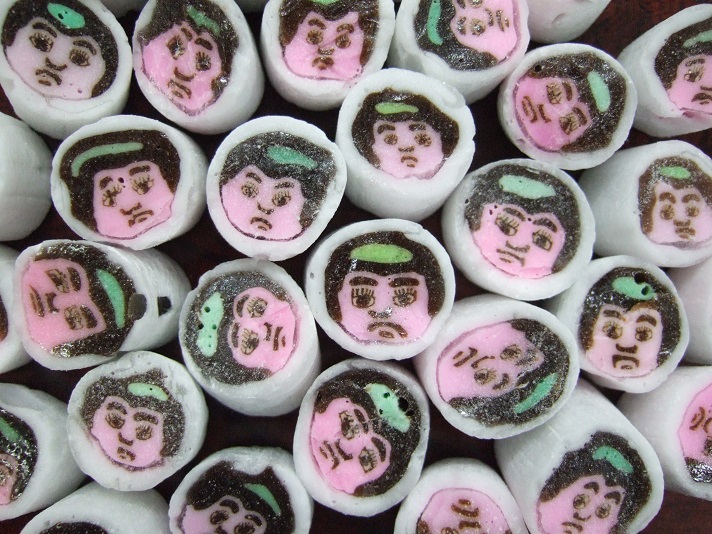
Kintarō-ame Akio WATANABE CC BY-SA 3.0
#/media/File:%E9%87%91%E5%A4%AA%E9%83%8E%E9%A3%B4.JPG)
When I thought about how to interpret Fangor’s paintings for a digital medium, I thought about these candies—but not uniformly structured like them. What if space were filled with colors, and we could cut it with any plane to reveal different expressions? Can I embed an infinite number of Fangor’s paintings into a space, and how does it feel to dwell in such a space?
ファンゴルの絵画をデジタル媒体に向けて解釈する方法を考えたときに、これらのキャンディーが頭に思い浮かびました。ただし金太郎飴のように均一な構造ではありません。空間が色で満たされていて、任意の平面で切り取ることで異なる表現が現れるとしたらどうでしょう。無限のファンゴルの絵画を空間に埋め込むことができたら、そのような空間に佇んだらどんな感じがするでしょう。
Fangor
ファンゴル
Wojciech Bonawentura Fangor (15 November 1922 – 25 October 2015), also known as Voy Fangor, was a Polish painter, graphic artist, and sculptor. Described as “one of the most distinctive painters to emerge from postwar Poland”, Fangor has been associated with Op art and Color field movements and recognized as a key figure in the history of Polish postwar abstract art. (wikipedia)
ヴォイチェフ・ボナヴェントゥラ・ファンゴル(1922年11月15日 - 2015年10月25日)は、Voy Fangorとしても知られる、ポーランドの画家、グラフィックアーティスト、そして彫刻家です。ファンゴルは「戦後ポーランドから登場した最も独特な画家の一人」と評され、オプ・アートとカラー・フィールド運動に関連し、ポーランドの戦後抽象芸術の歴史における重要人物として認識されています。(ウィキペディア)
Fangor is a captivating artist. His paintings have a meditative quality; as you watch, the colors start to blend and vibrate, drawing you into the depths.
ファンゴルは魅力的な画家です。ファンゴルの瞑想的な質を持った絵画は、見ていると色が溶け合い振動し始め、深みへと引き込まれるような感じがします。
This year (13 July – 11 November 2024), Krupa Art Foundation is hosting a monographic exhibition featuring Fangor’s masterpieces, titled Wojciech Fangor: American Dream. And I had an invitation to exhibit my works alongside in the KAF Digital space.
今年(2024年7月13日〜11月11日)、クルパ・アート財団がファンゴルの傑作を取り上げた個展「ヴォイチェフ・ファンゴル:アメリカン・ドリーム」を開催するにあたり、併設のKAF Digital spaceで作品を展示するオファーを受けました。
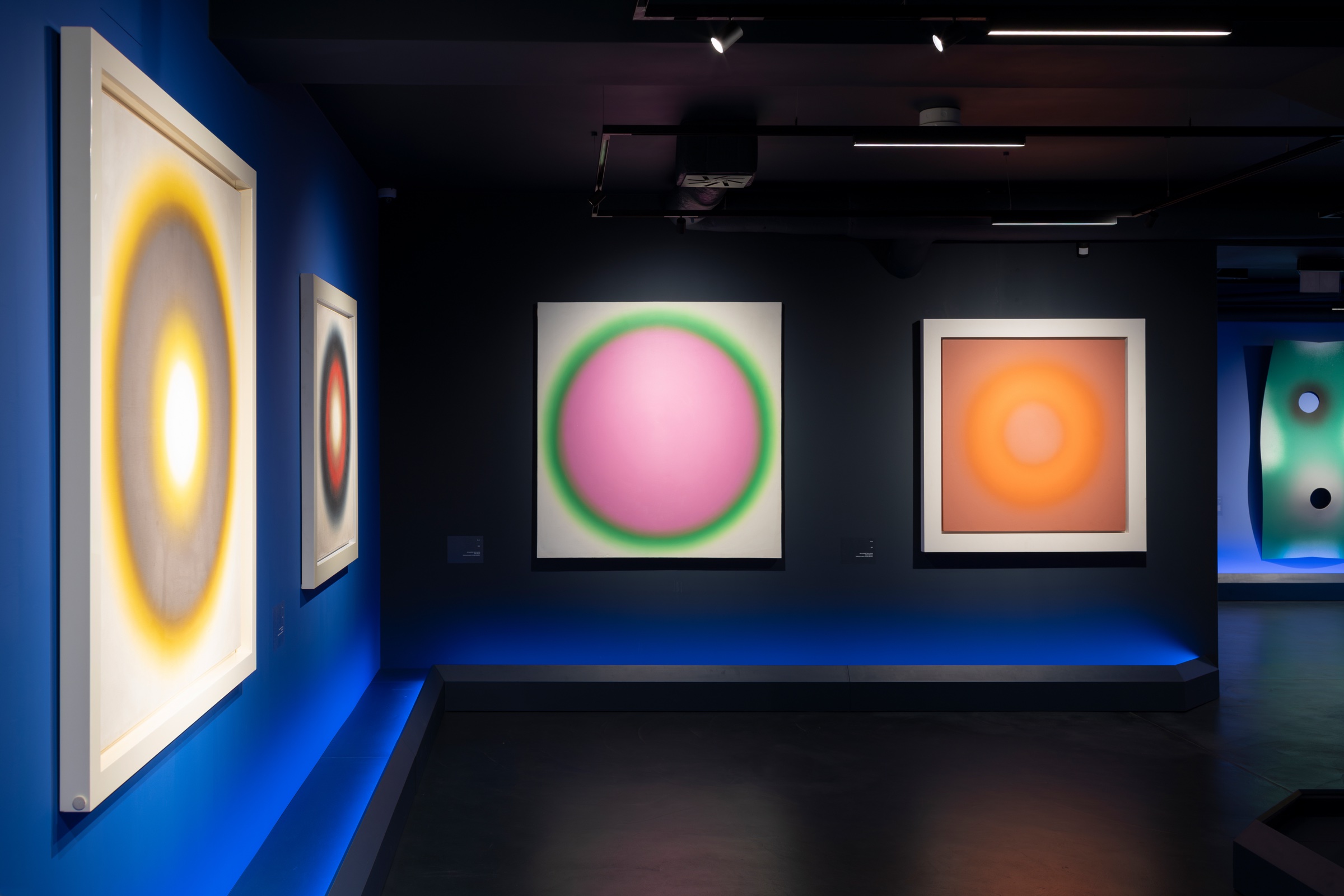
Wojciech Fangor: American Dream. Shot by Alicja Kielan
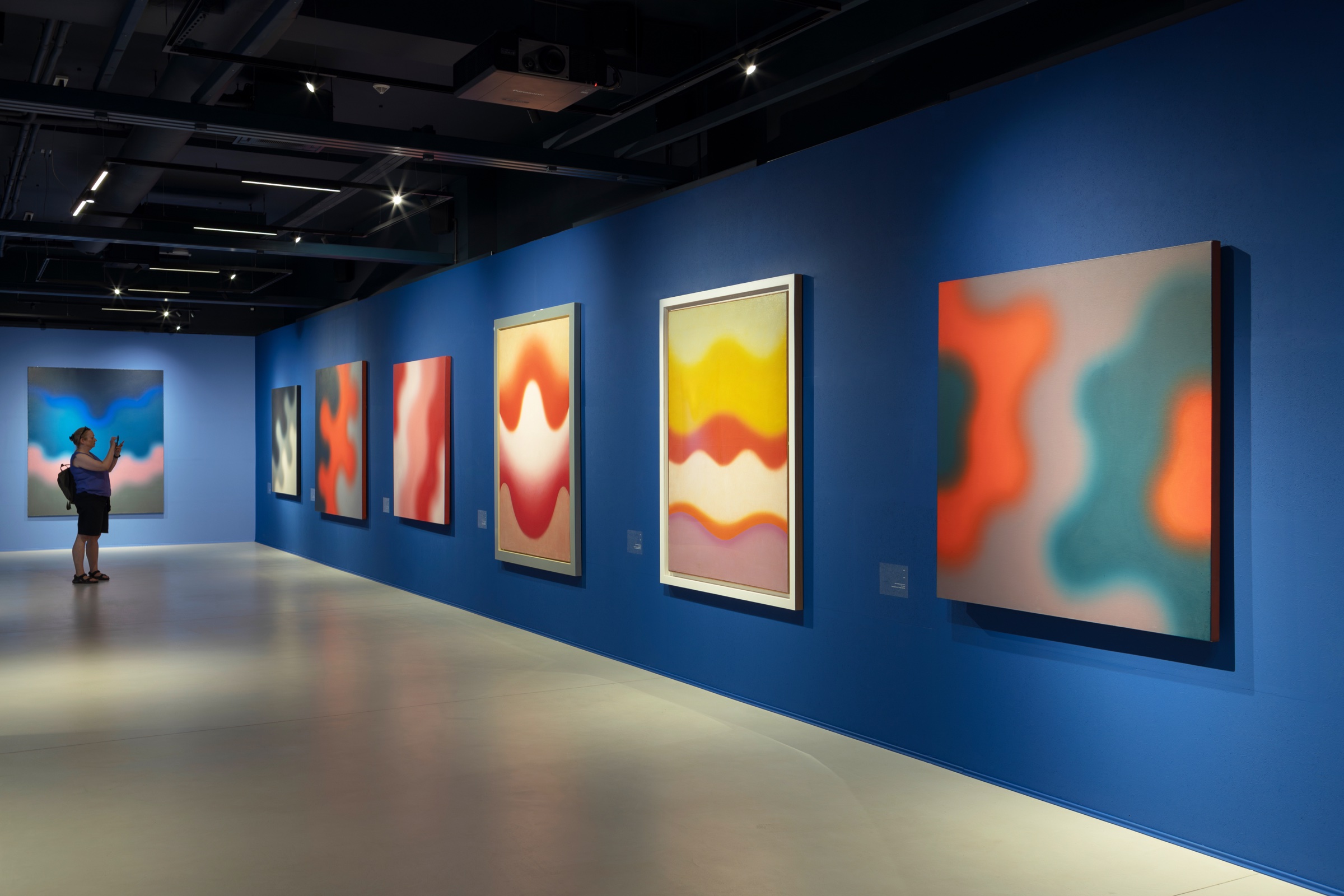
Wojciech Fangor: American Dream. Shot by Alicja Kielan
Field of Colors
色の場(フィールド)
So what does it mean to fill a space with colors? Imagine every particles in the air having hues that form an endless gradient throughout this space. Or think of it like taking various colors of modeling clay, shaping them into spheres and other forms, then blending them together into one enormous, colorful volume. Any slice of this space or volume will reveal a new image.
空間を色で満たすとはどういう意味でしょう。空気中のすべての粒子に色があり、無限に広がる空間全体にグラデーションを形成している様子を想像してみてください。またはカラフルなモデリング用の粘土を用意して球やその他の形を作り、それらを押しつぶして1つの巨大で色鮮やかな塊を作り上げる様子を考えてみましょう。これらの空間や塊のどの断面を切り取っても、新しい画像を得ることができます。
Speaking more mathematically or algorithmically, this space can be thought of as a field, or a function that returns a color when given a point in the space. Try the demo below. This showcases a cube with a little blurry sphere embedded. The gist of this demo is the vec3 sphereColor(vec3 p) function that returns an RGB color taking a point in 3D as input.
より数学的またはアルゴリズム的に言えば、この空間は場(フィールド)、つまり、任意の空間内の点に対して色を返す関数として捉えられます。下のデモを試してみてください。少しぼやけた球体が埋め込まれた立方体が表示されています。このデモの要は、3次元の点を入力として受け取り、RGBカラーを返すvec3 sphereColor(vec3 p)関数です。
vec3 sphereColor(vec3 p) {
  p -= vec3(0.5);
  float d = length(p);
  float l = smoothstep(0.5, 0.51, d);


  vec3 ca = mix(vec3(255.0, 20.0, 0.0) / 255.0, vec3(30.0, 120.0, 0.0) / 255.0, smoothstep(-1.0, 1.0, p.y));
  vec3 cb = mix(vec3(4.0, 80.0, 120.0) / 255.0, vec3(255.0, 208.0, 10.0) / 255.0, smoothstep(-1.0, 1.0, p.z));

  return mix(ca, cb, l);
}
We can animate the shape over time to make it more interesting, based on Fangor’s favorite motif—fuzzy concentric circles.
時間とともに形状をアニメーションさせて、より面白くものにすることもできます。これはファンゴルがよく用いる、ぼやけた同心円状のモチーフを元にしています。
This function can be anything—there’s nothing technically special about it. It’s simply a mapping from a 3D vector to another.
この関数は何でもかまいません。技術的に特別なものは何もなく、単に3次元ベクトルから別のベクトルへのマッピングです。
It’s more about my mental model. I love imagining Fangor’s vibrant colors filling the space around me. You can interpret the same function or data in various ways, but I just enjoy this particular interpretation.
これは頭の中にどんなモデルを描くかの問題です。同じ関数やデータでも様々な解釈をすることができますが、ファンゴルの鮮やかな色彩が周りの空間を満たしていく様子を想像するのが楽しいのです。
This is another demo based on another of Fangor’s recursive motifs—waves.
下は、ファンゴルが繰り返し用いるもうひとつのモチーフである波をベースにしたデモです。
Renderings
レンダリング
Here are some test renderings for the exhibition, including the black and white versions we couldn’t use due to time constraints.
下は上映時間の制約で使えなかった白黒バージョンも含まれた、展示のためのテストレンダリングです。
A great advantage of this approach is that it is easy to ensure seamless connection at the edges of the walls. Since it’s a large volume cut by the walls’ surface, the colors connect automatically. Though there will be cusps depending on how the edges intersect with the shapes, even when they’re smooth in 3D space.
このアプローチの大きな利点は、壁の端でのシームレスなつながりを簡単に実現できることです。大きな塊を壁の面で切り取って表示しているので、角の色は自動的につながります。ただし、3D空間で滑らかな形状でも、エッジが形状と交差する方法によっては尖った形状が生じる可能性はあります。
These works are exhibited along with the pieces by Zach Lieberman and Yoshi Sodeoka.
この作品は Zach Lieberman や Yoshi Sodeoka の作品と一緒に展示されています。
The Positive Immersive Space - KAF Digital
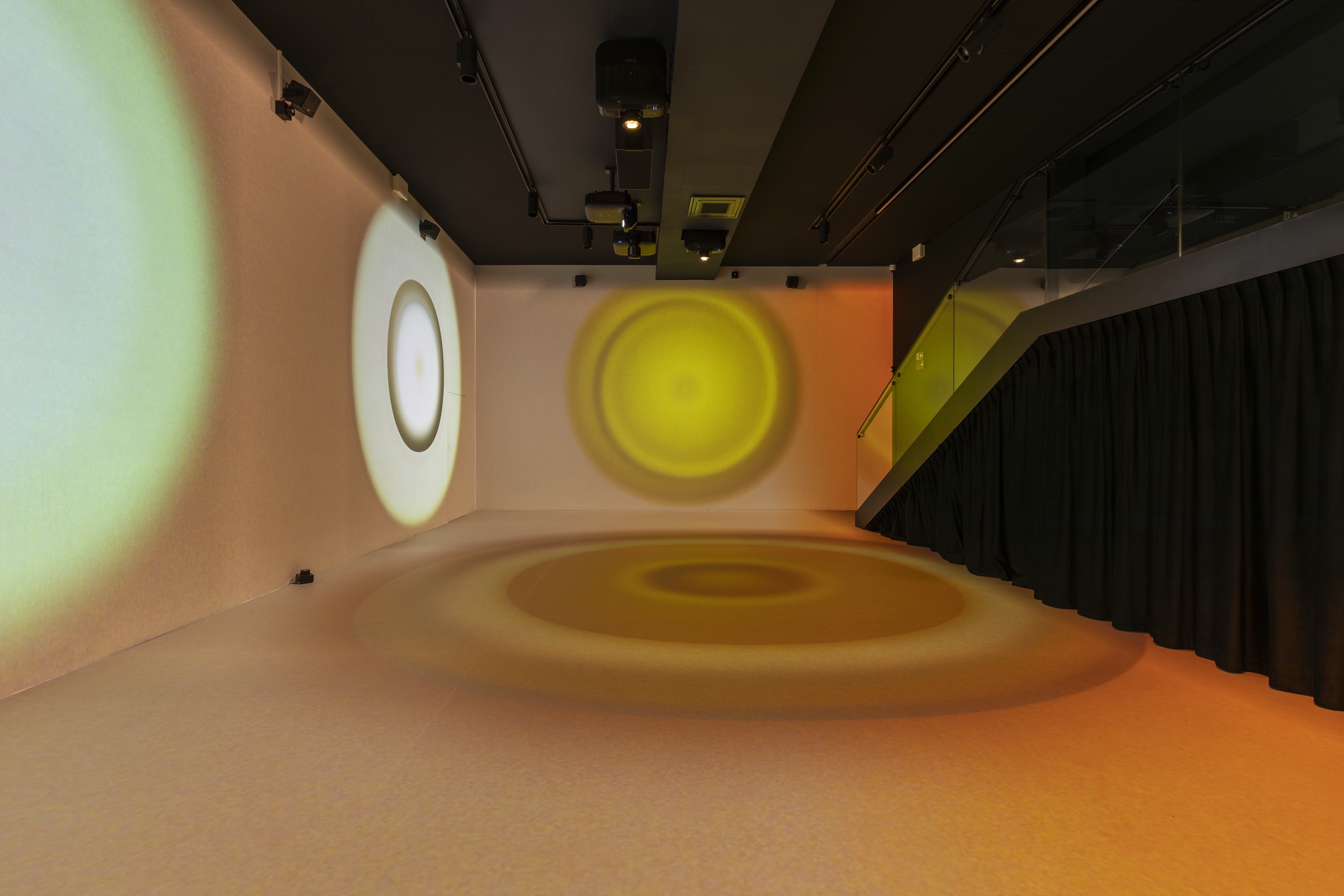
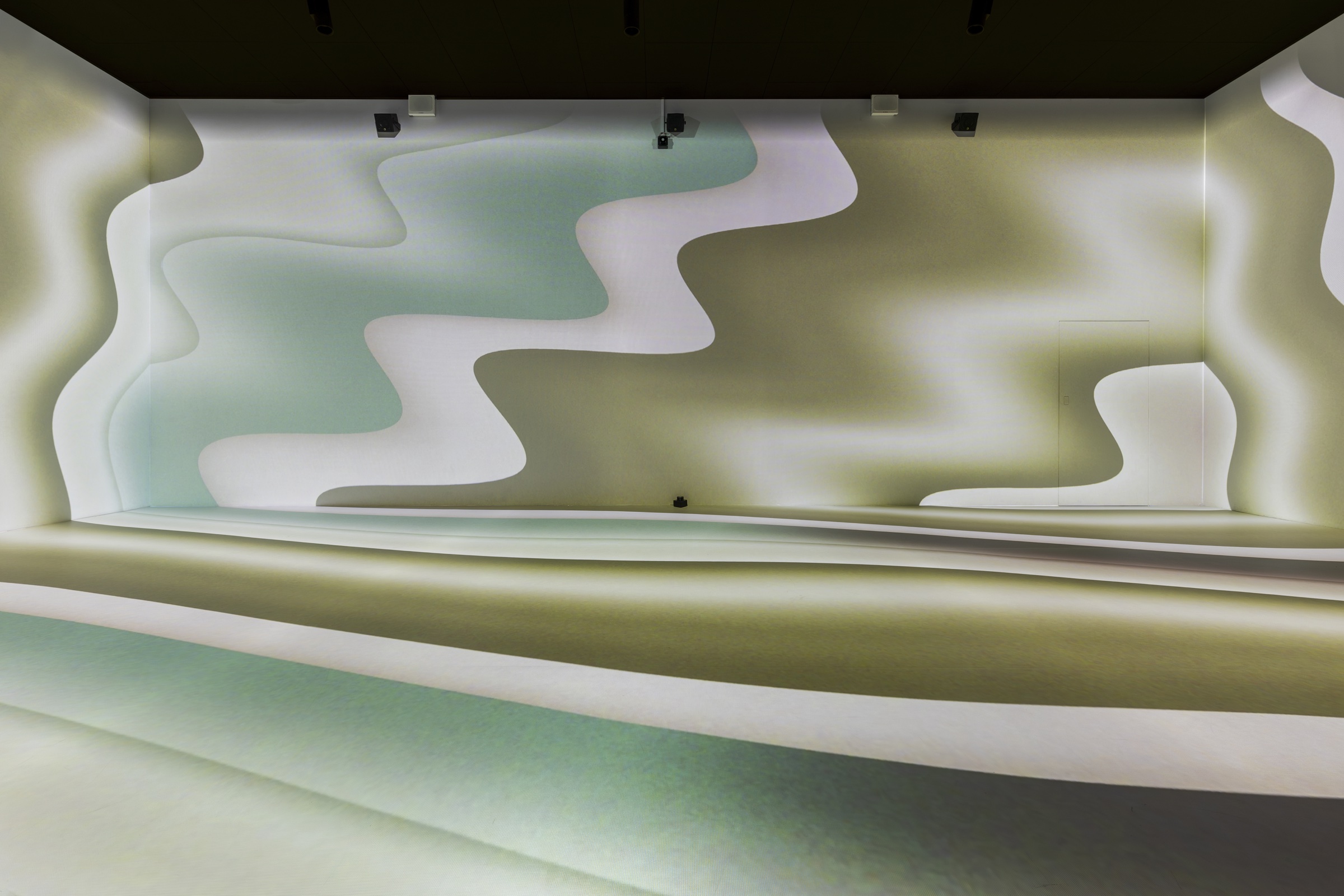
Photo by Alicja Kielan
Slicing multi-dimensional spaces
多次元空間をスライスする
It’s fascinating to contemplate structures in space that exist even when we can’t see them. Next time you see a circle like Fangor’s, try imagining it as a sphere. Or when you see a sphere, picture it as a slice of a 4D sphere (hypersphere). To dive deeper into this topic, jump on to Dimensions 次元.
実際に見えなくても空間内に存在する構造について考えるのは楽しいものです。次にファンゴルの絵画のような円を見たときは、それを球体として想像してみてください。球体を見たときには、4次元球体(超球体)の断面として想像してみましょう。このトピックについて深く掘り下げるには、Dimensions 次元をみてください。