The secrets of sound (for kids)
PDF for printing
Pitch and Frequency
Sound is a Wave
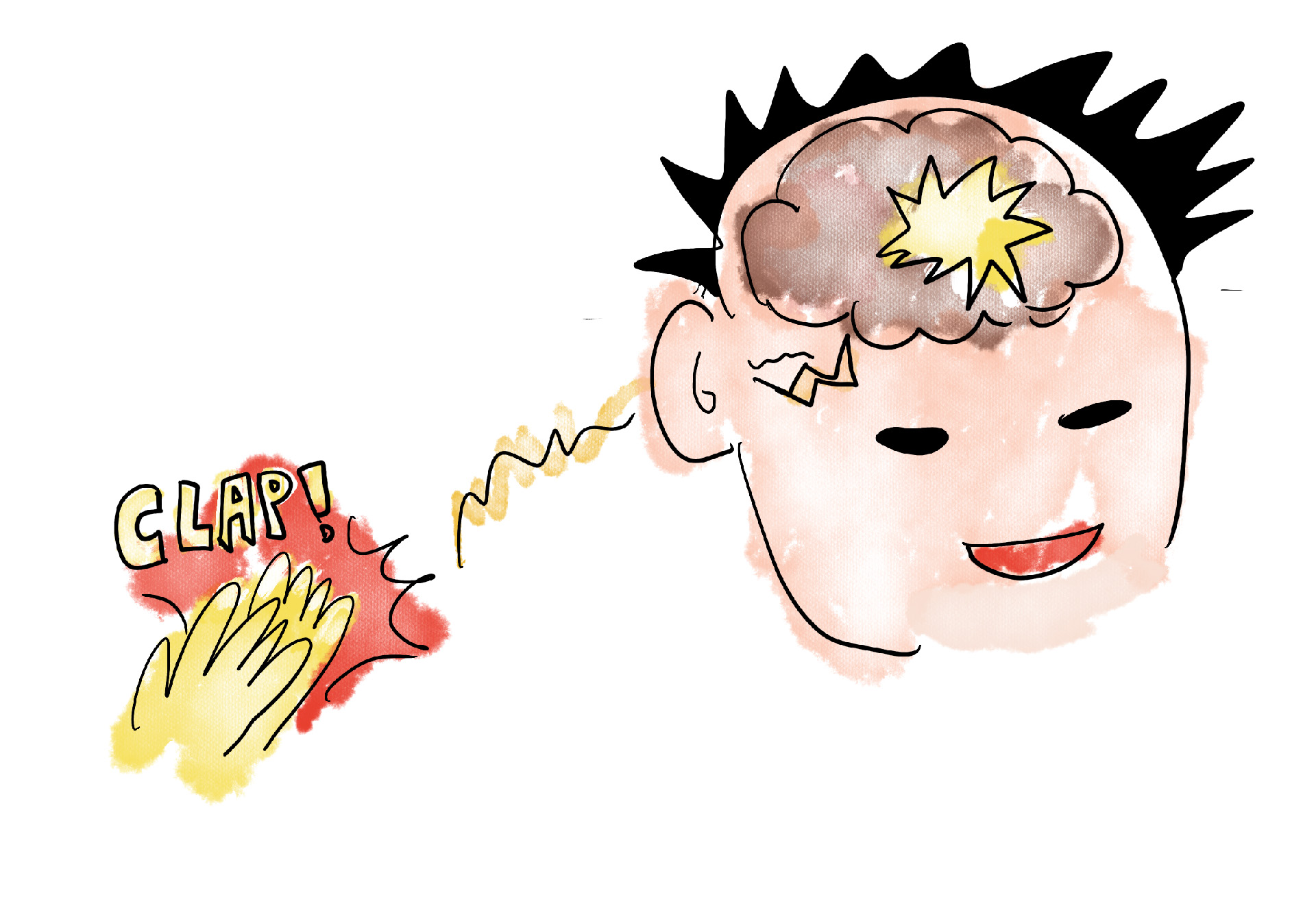
Sound is a wave. When you clap your hands, pluck a string, or hit a drum, it makes the air wiggle! These wiggles are called sound waves, and they travel to your ears. It’s like when you throw a rock into water and see ripples spreading out. Sound waves are like ripples, but they move through the air instead of water!
What is Oscillation?
Imagine a swing going back and forth at the playground. That back-and-forth motion is called oscillation. In sound waves, the air wiggles back and forth like the swing. This is how sound travels, bringing us music, talking, and all the sounds we hear!
What is Frequency?
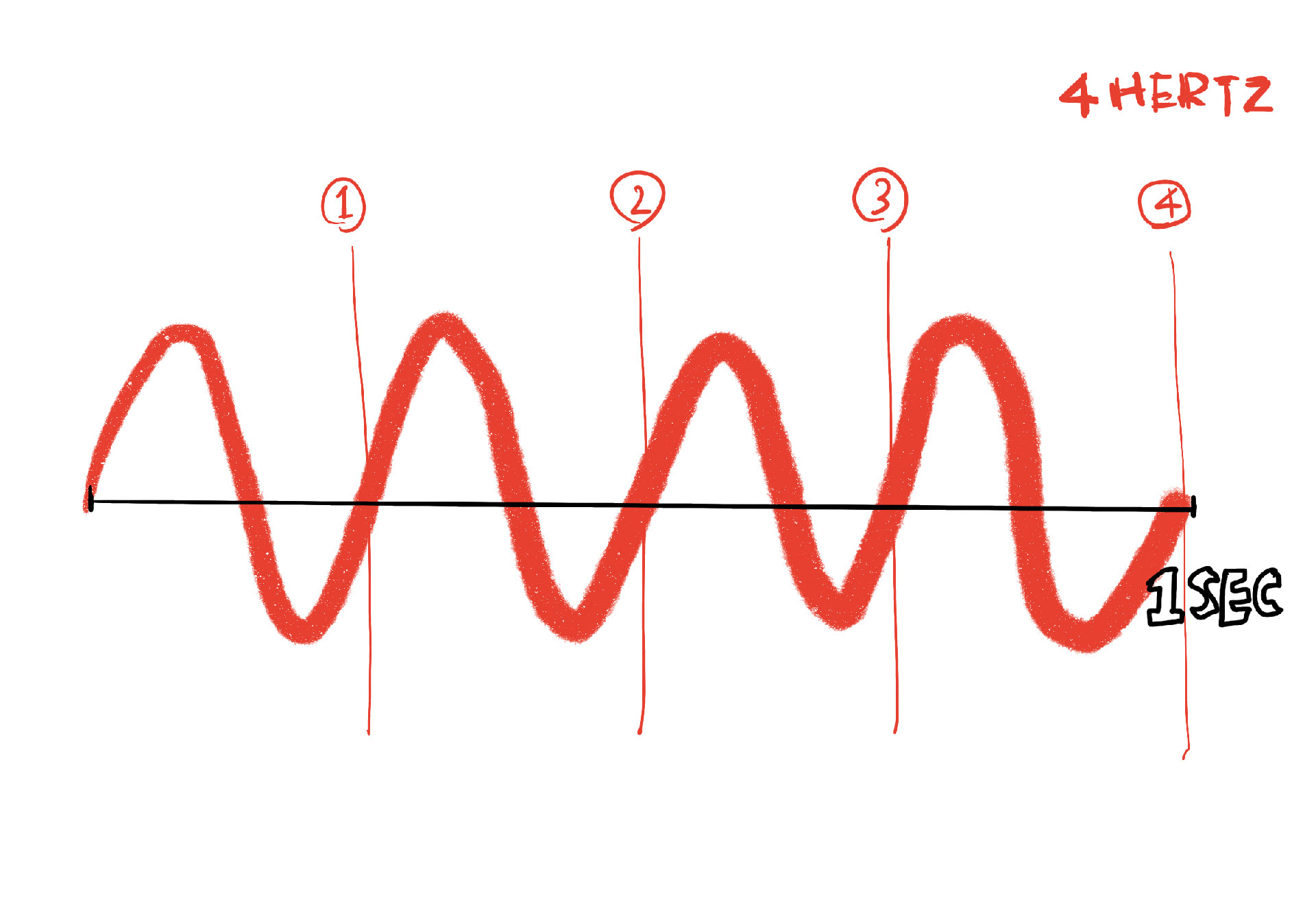
Let’s talk about how fast those swings—or waves—move. Frequency is a big word that means “how many times something wiggles back and forth in one second.” Scientists use a special name for this: hertz (Hz). It’s like counting how many times a swing goes back and forth every second!
High and Low Sounds
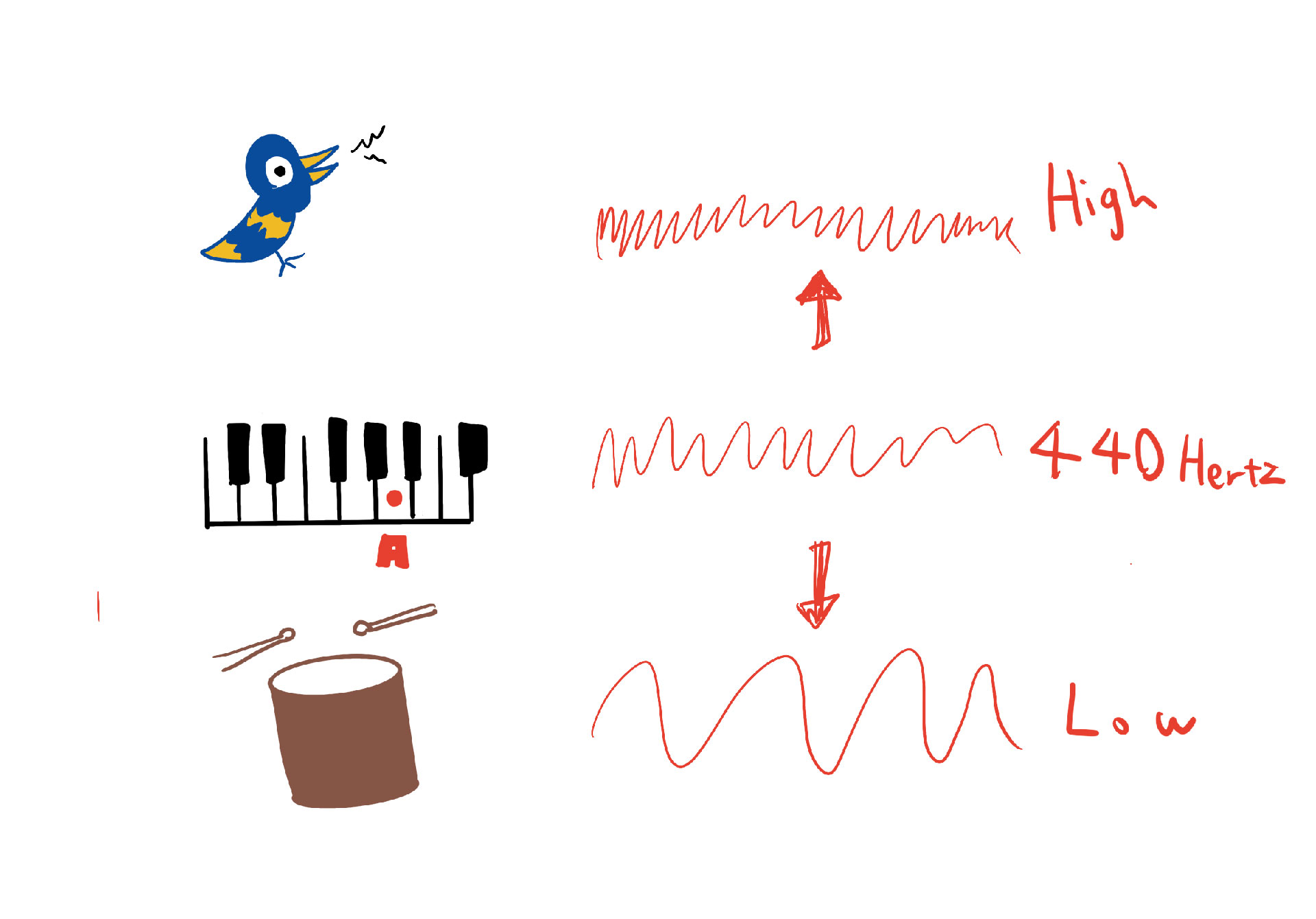
If something wiggles 440 times every second, its frequency is 440 Hz. That’s the sound of the A note in the middle of a piano.
Your ears hear different frequencies as high or low sounds:
-
A high frequency sounds like a bird chirping or a whistle.
-
A low frequency sounds like a big drum or a big dog’s bark.
The faster something wiggles, the higher the sound. The slower it wiggles, the lower the sound. Fun, right?
Pythagoras and His Cool Findings
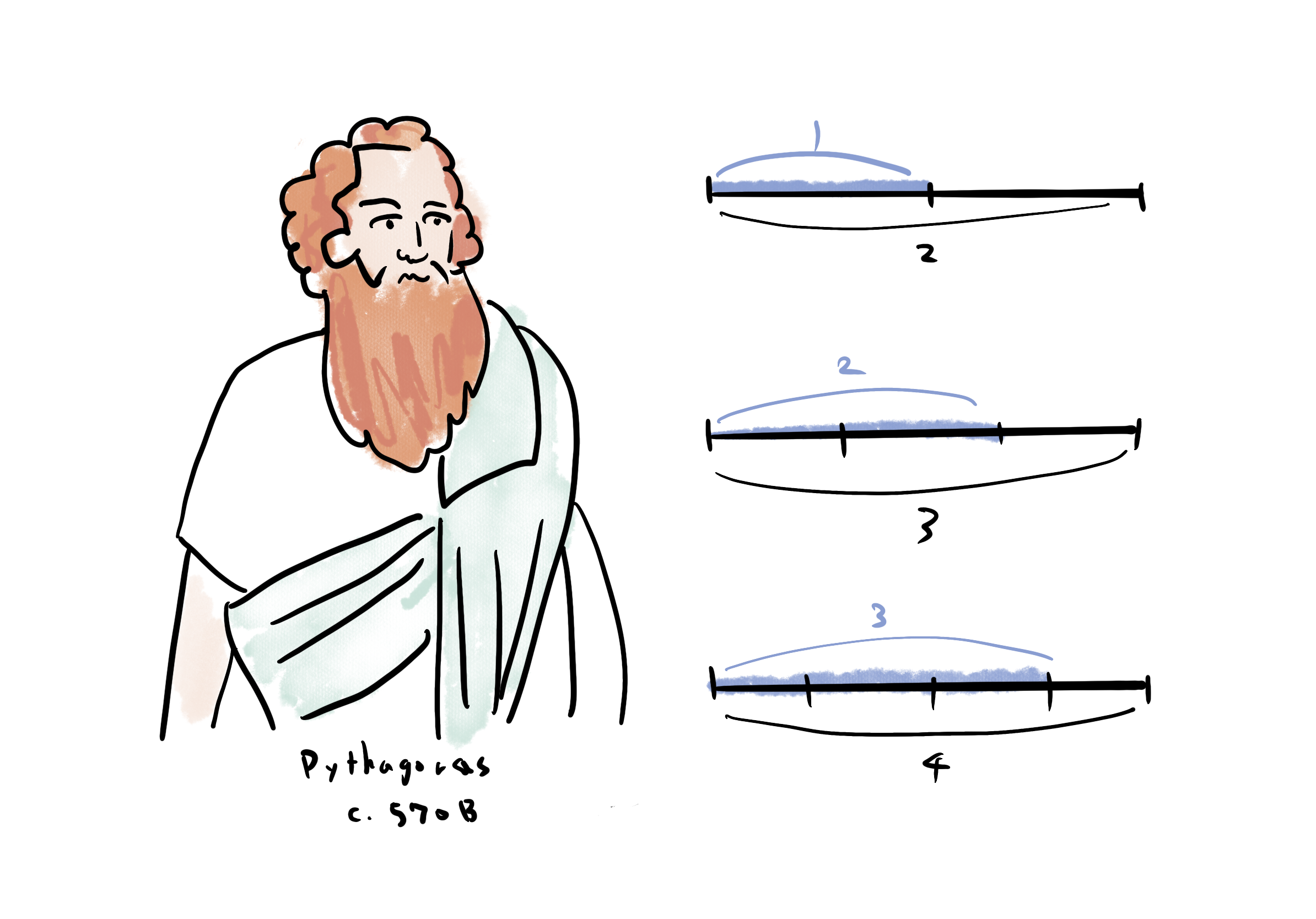
A long, long time ago, there was a really smart guy named Pythagoras (say it like “pie-THA-go-ras”). He made an amazing discovery: music and math are best friends!
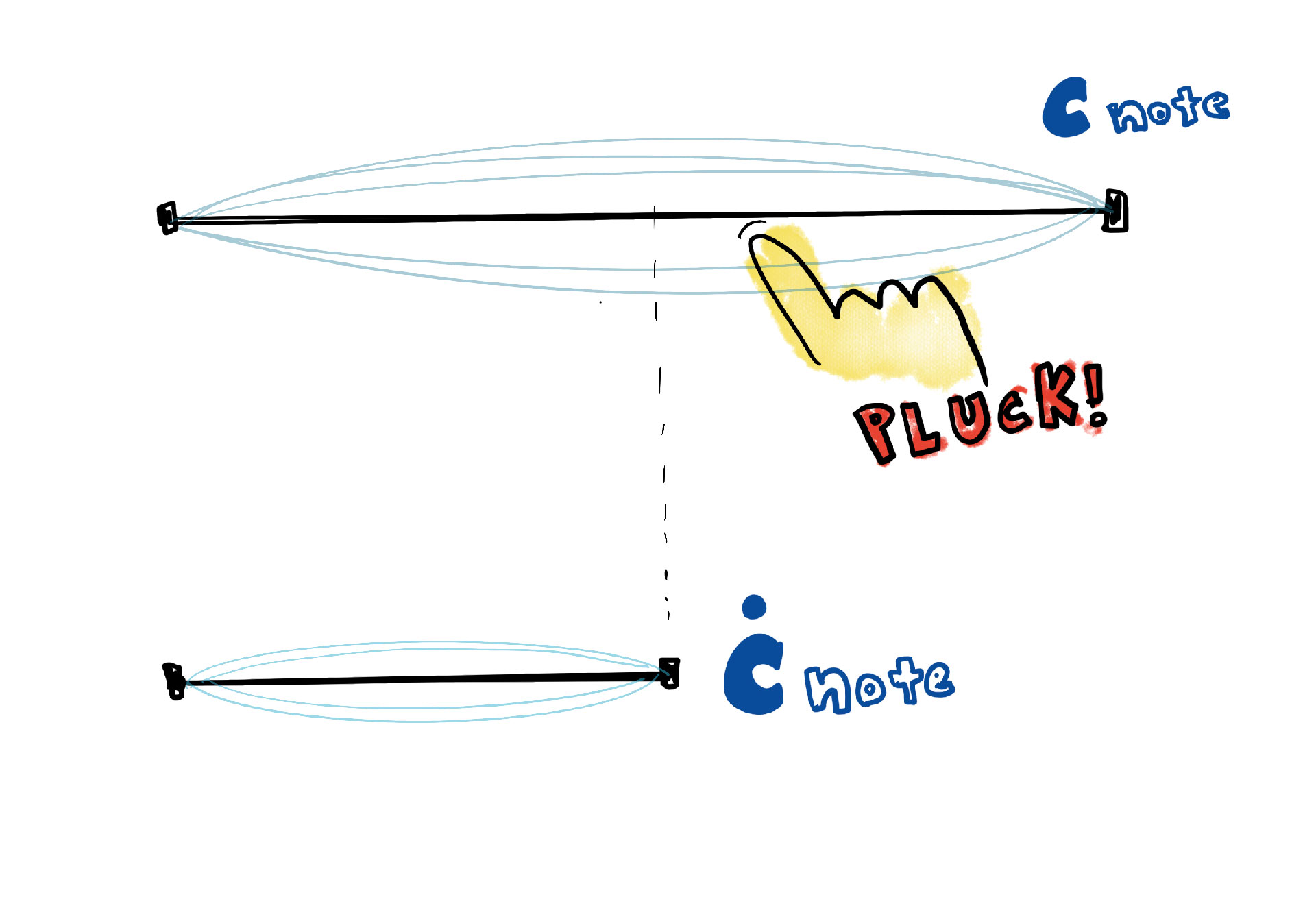
Pythagoras discovered that if you divide a string into two equal parts and pluck it, the sound it makes is higher but still feels like it matches the first sound. This is called an octave. It’s like when you play a C note on a piano and then a higher C—they sound like they belong together, even though one is higher.
Magic Ratios
Pythagoras didn’t stop there. He figured out that dividing a string into different parts makes other musical notes, and the ones that sound great together come from simple math! Here’s what he found:
-
2:1 = An octave (like C and the higher C on a piano).
-
3:2 = A fifth* (like C to G).
-
4:3 = A fourth* (like C to F).
These numbers, called ratios, are like magic rules for making music that sounds beautiful!
“Fifth” and “Fourth” mean how far two notes are apart.
Start on C, count: C (1), D (2), E (3), F (4), G (5). So, G is the fifth note from C.
Start on C, count: C (1), D (2), E (3), F (4). So, F is the fourth note from C.
Try This at Home!
Here’s a fun way to see what Pythagoras discovered:
What You Need
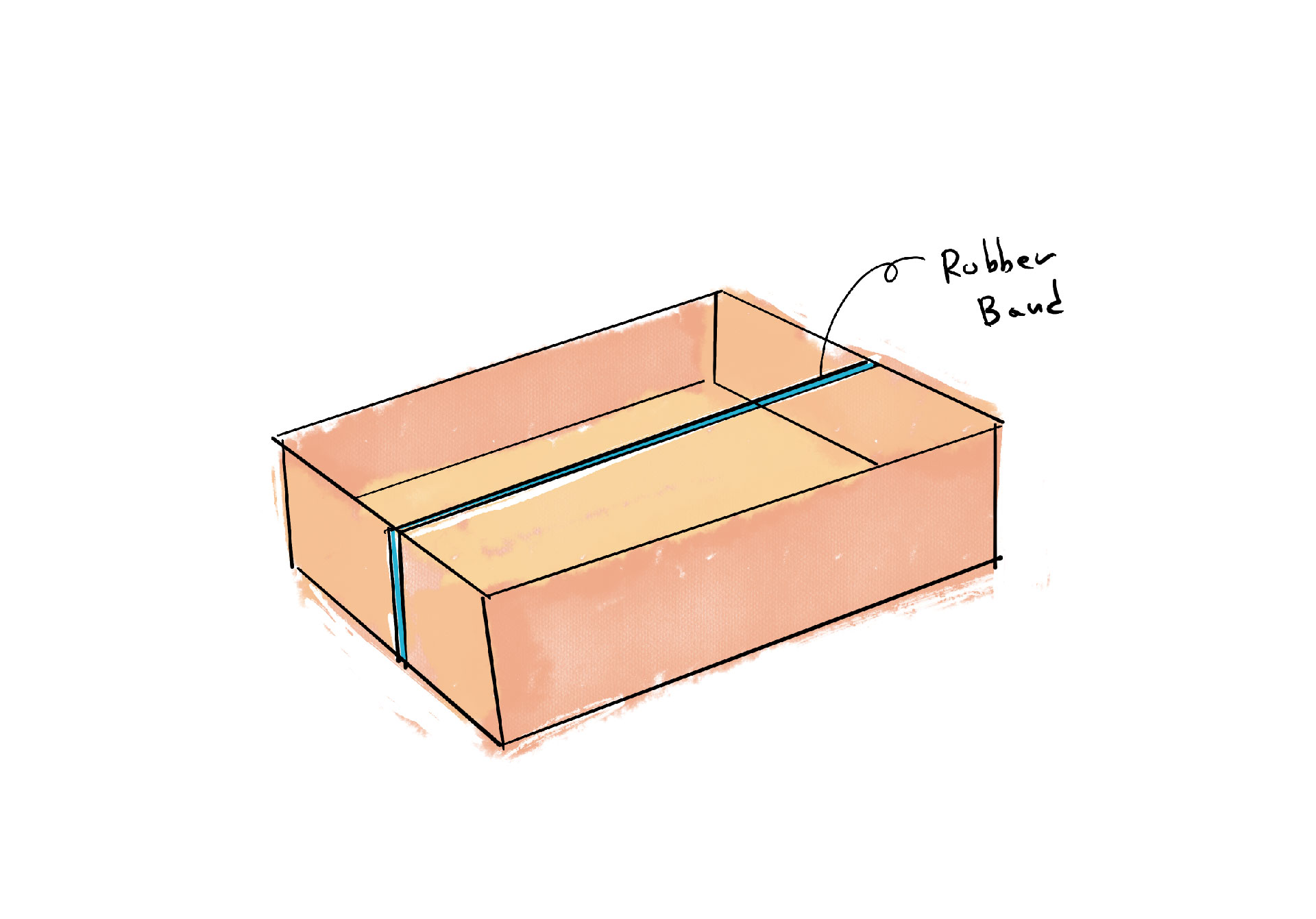
- A rubber band stretched over a box (or a stringed instrument if you have one).
What to Do:
-
Pluck the whole rubber band and listen to the sound.
-
Now pinch the rubber band in the middle and pluck one side. Do you hear the sound getting higher?
-
Try pinching it at other spots, like one-third or one-fourth, and see how the sound changes!
The Circle and Shapes of Notes
The Circle of Notes
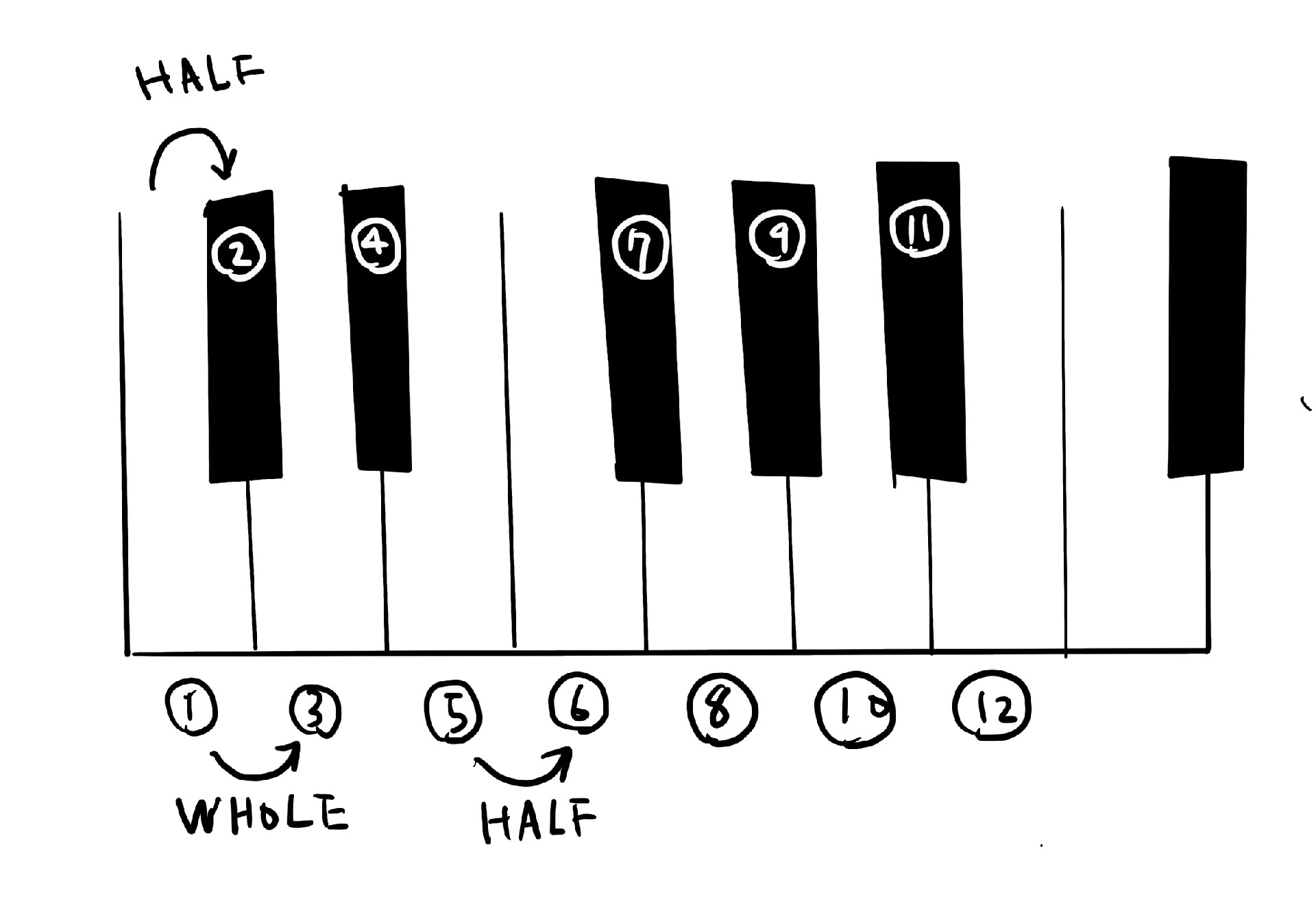
Do you know how many notes there are in an octave? Let’s count them on a piano! If you start from a C note and count all the white and black keys on the way up, you’ll find there are 12 keys until you get to the next C.
Half Steps and Whole Steps
Each step between the notes is called a half step. If you count two steps, that’s called a whole step. These steps are like tiny building blocks that make up all the music we hear!
Making a Circle of Notes
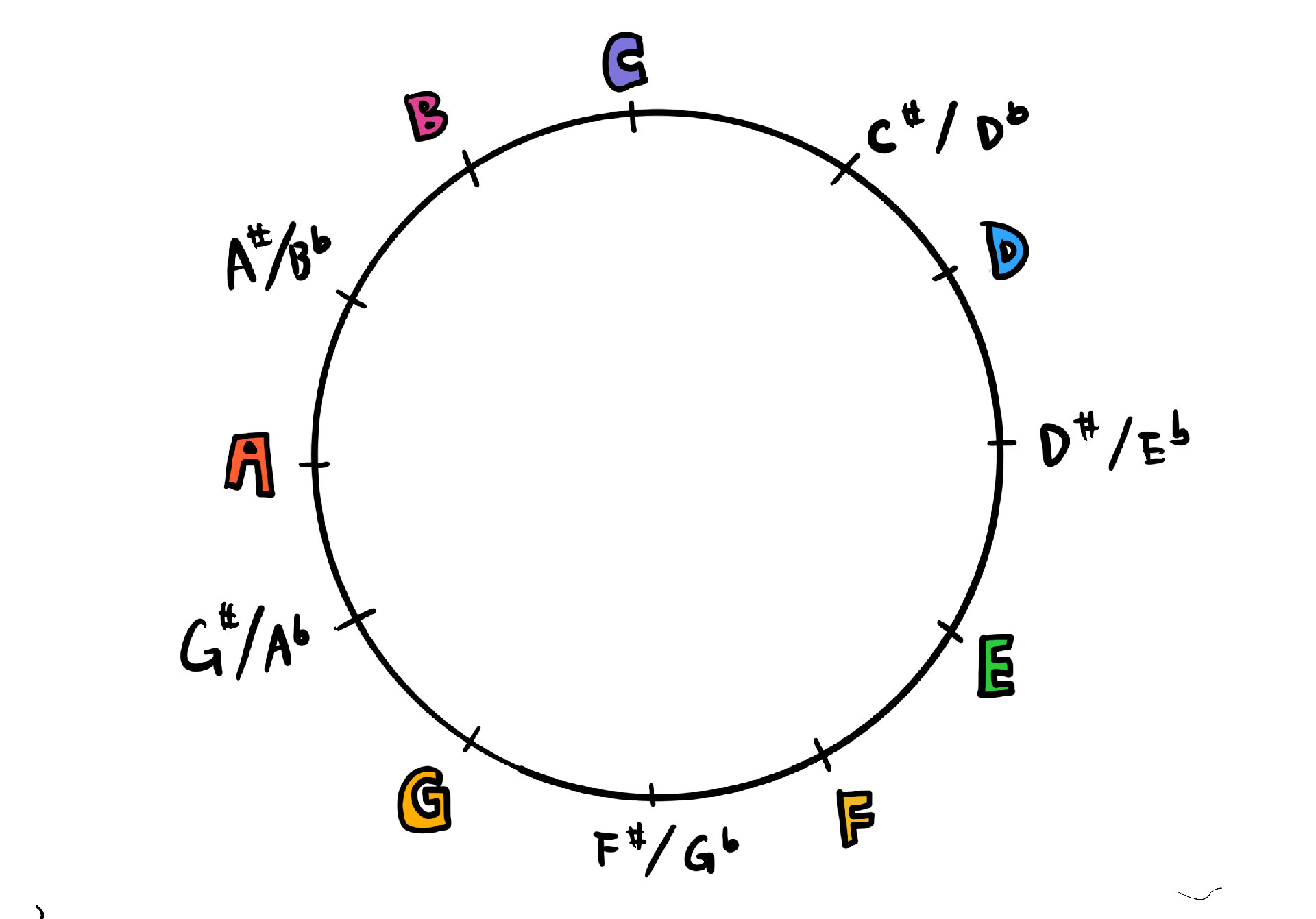
Let’s take those 12 notes and put them on a big circle, like a clock:
-
Start at the top with C.
-
Go around and add the other notes in order
C | C#/Db | D | D#/Eb | E | F | F#/Gb | G | G#/Ab | A | A#/Bb | B | C
Now you have a magical music map! This circle helps us see how notes are connected.
Major Scale
A scale is a group of notes that belong together. Each scale has its own sound or feeling—some can be happy, or sad, and some feel calm or exciting. It helps us choose which notes to play and how to create a melody!
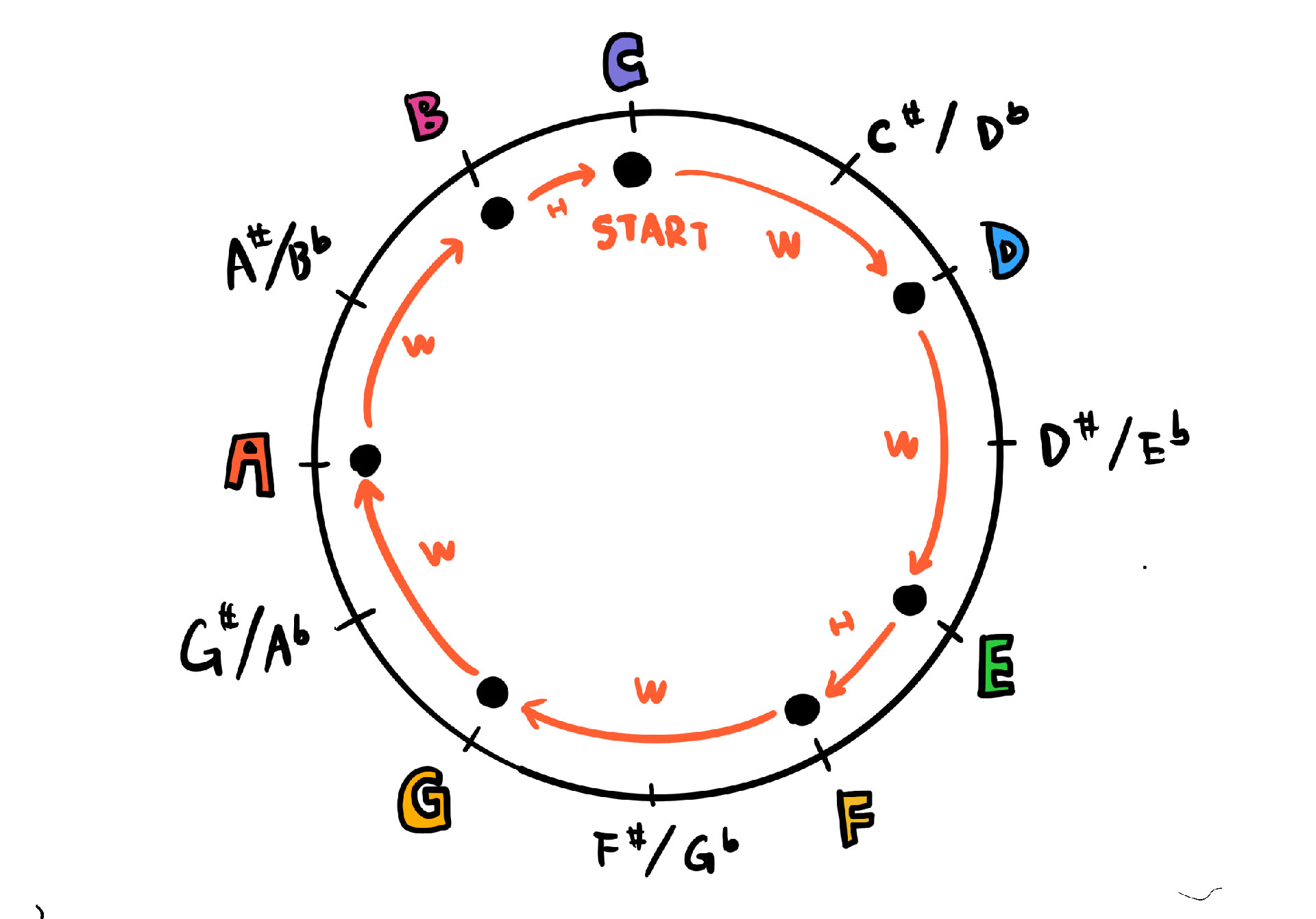
Let’s mark all the white keys on the piano on our circle of notes. Look closely: some notes are separated by a whole note (2 steps), and others by a half note (1 step). If you call them out in order, the pattern is:
Whole, Whole, Half, Whole, Whole, Whole, Half.
This pattern is what makes a major scale sound the way it does. This scale is called the C major scale because it is a major scale that starts from C.
Try Moving the Pattern
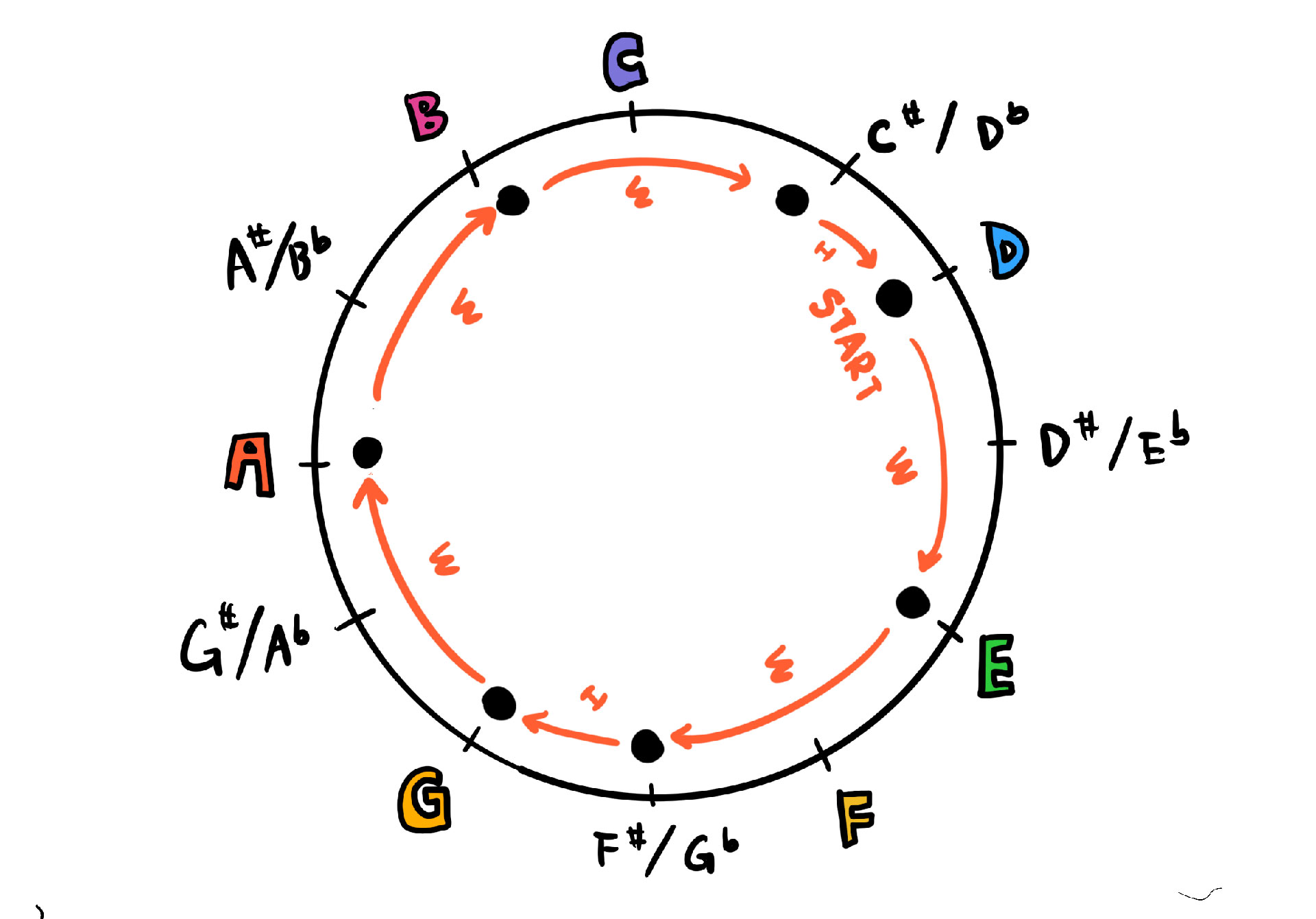
Now let’s start the same pattern, but this time from the D note instead of C. Keep the same Whole, Whole, Half, Whole, Whole, Whole, Half relationship.
Play it on the piano (or any instrument you have) and hear how it sounds! It’s still a major scale, but starting on D gives it a fresh, new sound. This is called the D major scale.
Minor Scale
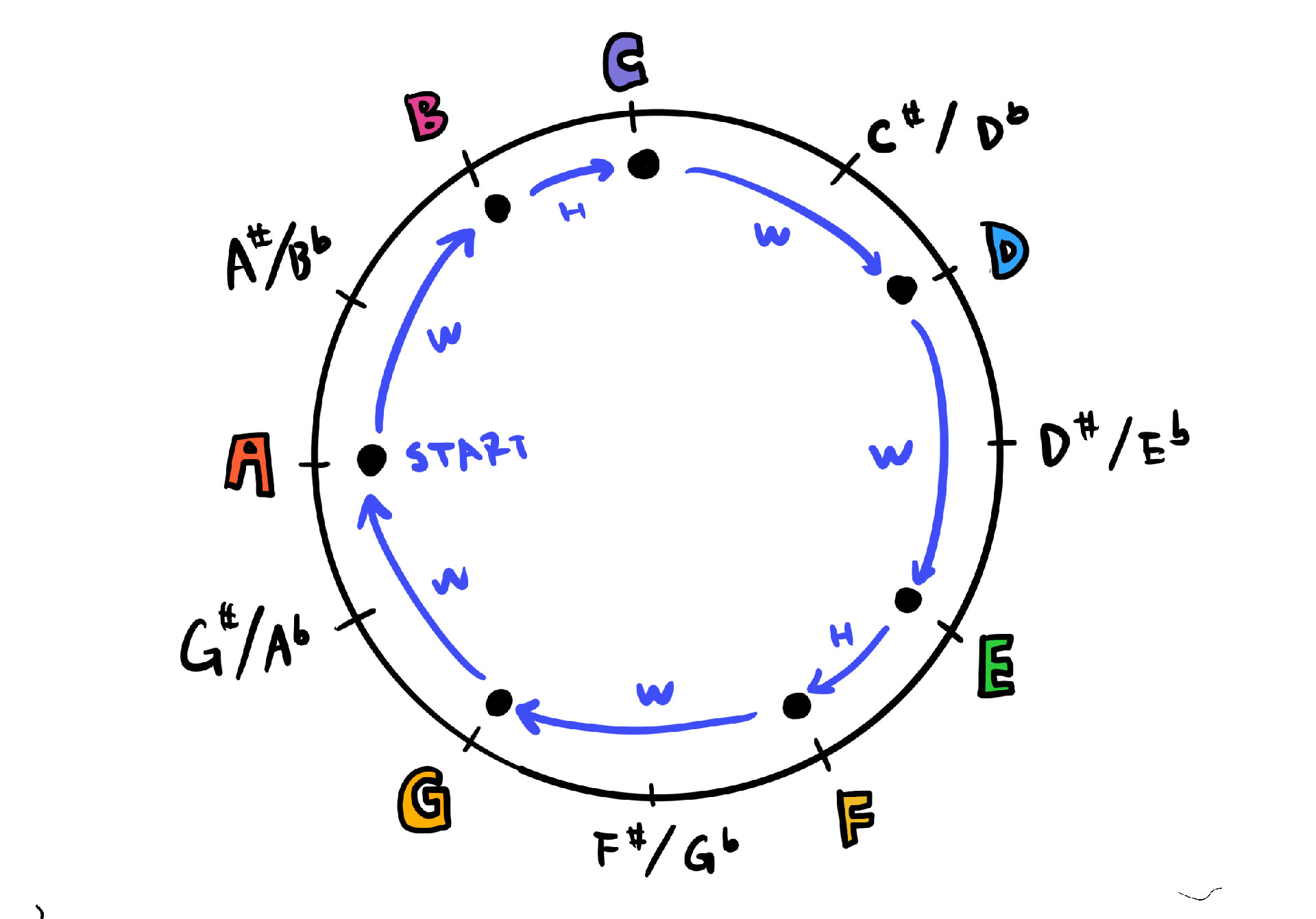
Let’s try a different kind of scale. Start from the A note on the piano and play all the white keys until you reach the next A. How does it sound? Many people think it sounds a little sad or serious (but you don’t have to agree, everyone can hear music differently). This is called a minor scale.
The relationship between the notes in a minor scale is:
Whole, Half, Whole, Whole, Half, Whole, Whole.
Try a Minor Scale on a New Note
Now, can you try playing a minor scale starting from a different note, like F? Remember to keep the same Whole, Half, Whole, Whole, Half, Whole, Whole pattern as you go. Listen carefully—does it still sound like a minor scale?
Pentatonic scale
The pentatonic scale is a scale with only five notes (penta- means five). This scale is used in many styles of music, like rock, blues, soul, and traditional music from around the world. It’s also great for improvisation, which means making up music as you play!
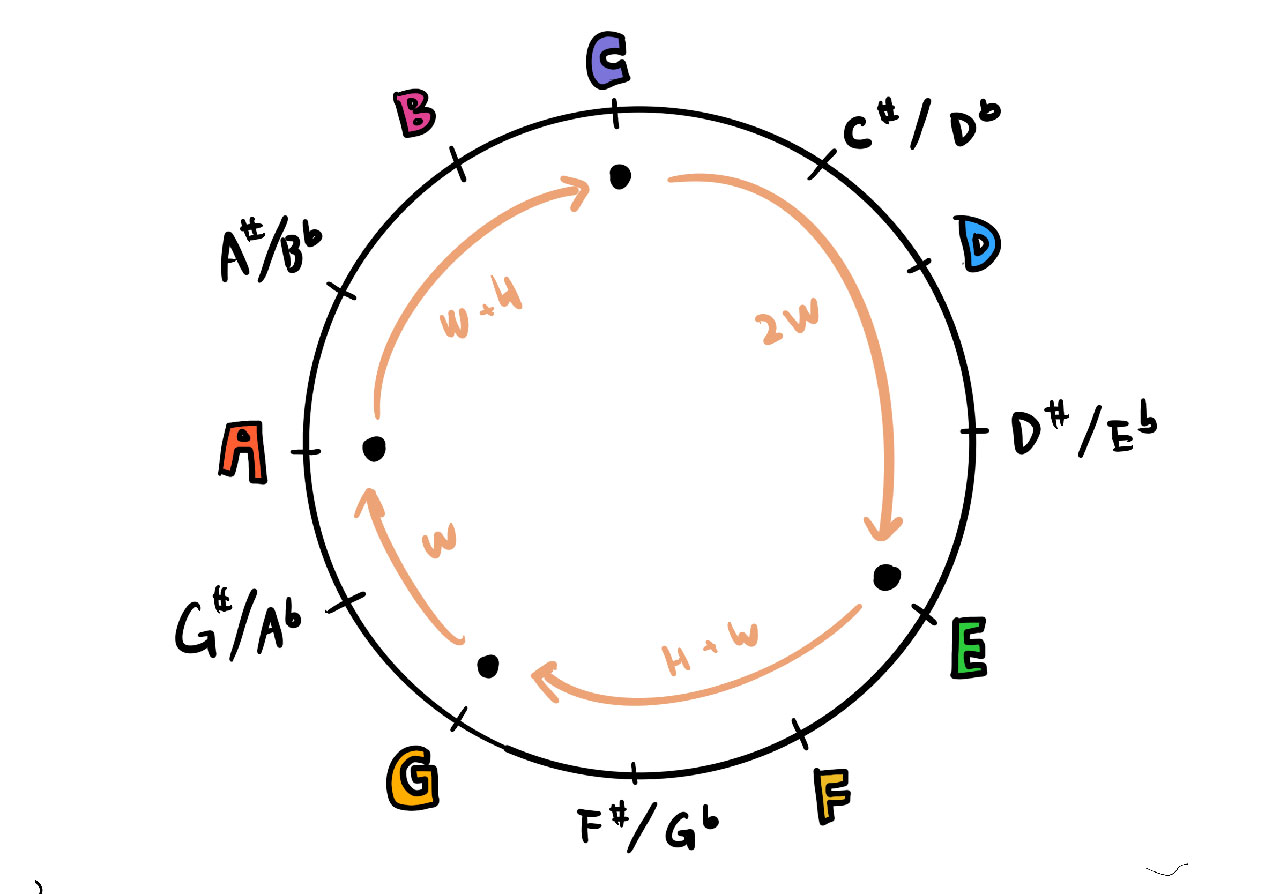
The pattern on the circle below is called the C major pentatonic. The steps are:
-
2 Whole notes (4 half steps, also called a major 3rd)
-
Half + Whole notes (3 half steps, also called a minor 3rd)
-
Whole note (2 half steps)
-
Whole + Half notes (3 half steps, also called a minor 3rd).
Try playing this on an instrument. Can you play this starting from another note? If you can, play a song on a music player and find a pentatonic scale that sounds “good” with the song!
These are not the only scales. There are so many others to explore! As you study music more, you’ll discover new scales, each with its own unique sound and feeling.
Major Chord
A chord is when you play several notes together at the same time. Let’s make a major chord, which is often thought to be happy and bright.
-
Start with the C note.
-
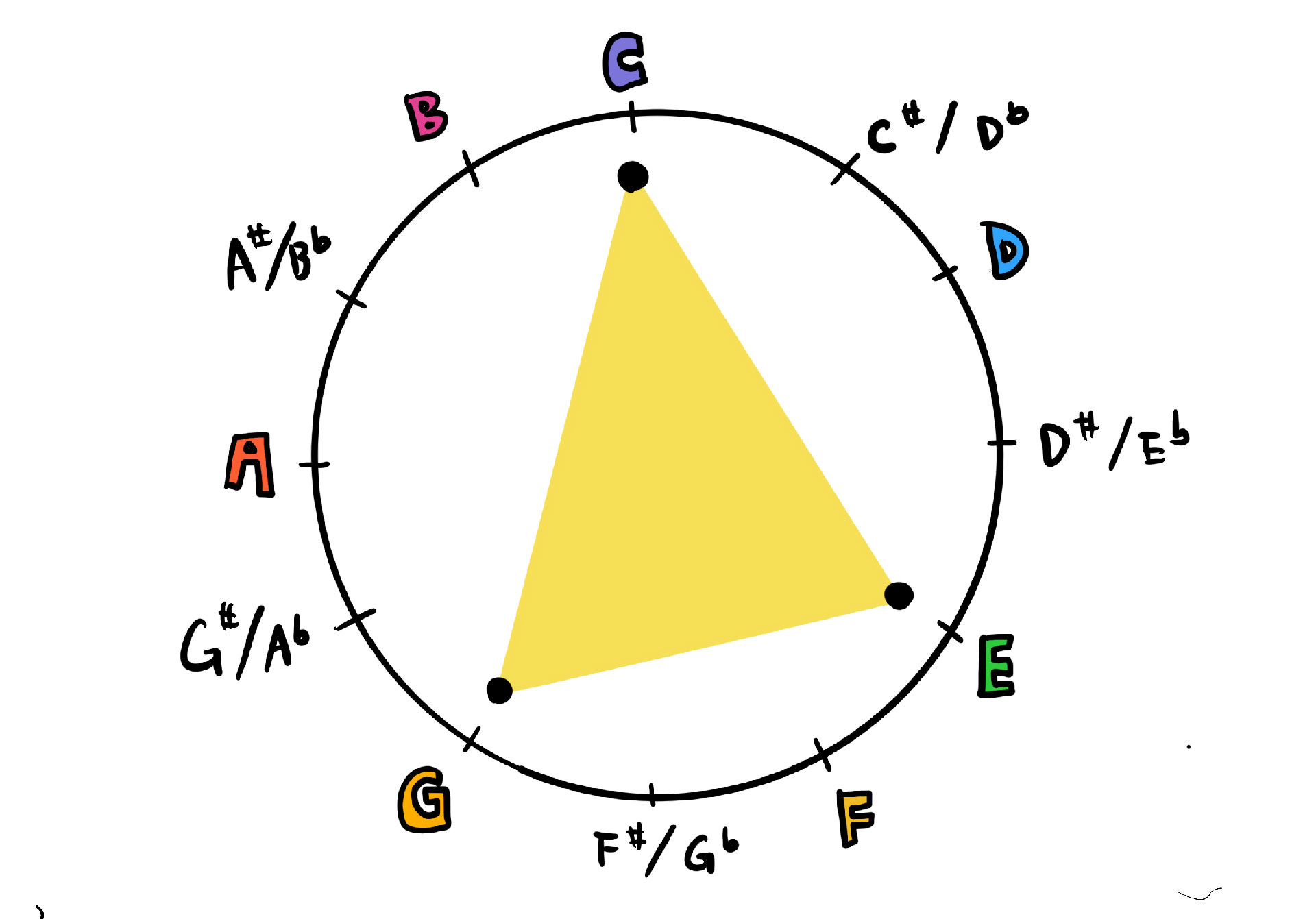
Count 4 steps (a major third) to the next note: E.
-
Count 3 steps (a minor third) to the next note: G.
Play C, E, and G together on the piano. That’s a C Major Chord!
On the circle, look at the triangle shape that the notes make. Can you rotate this triangle on the circle and play it? Does it sound similar?
Minor Chord
Now let’s try a minor chord, which might sound a little sad or mysterious.
-
Start with the A note.
-
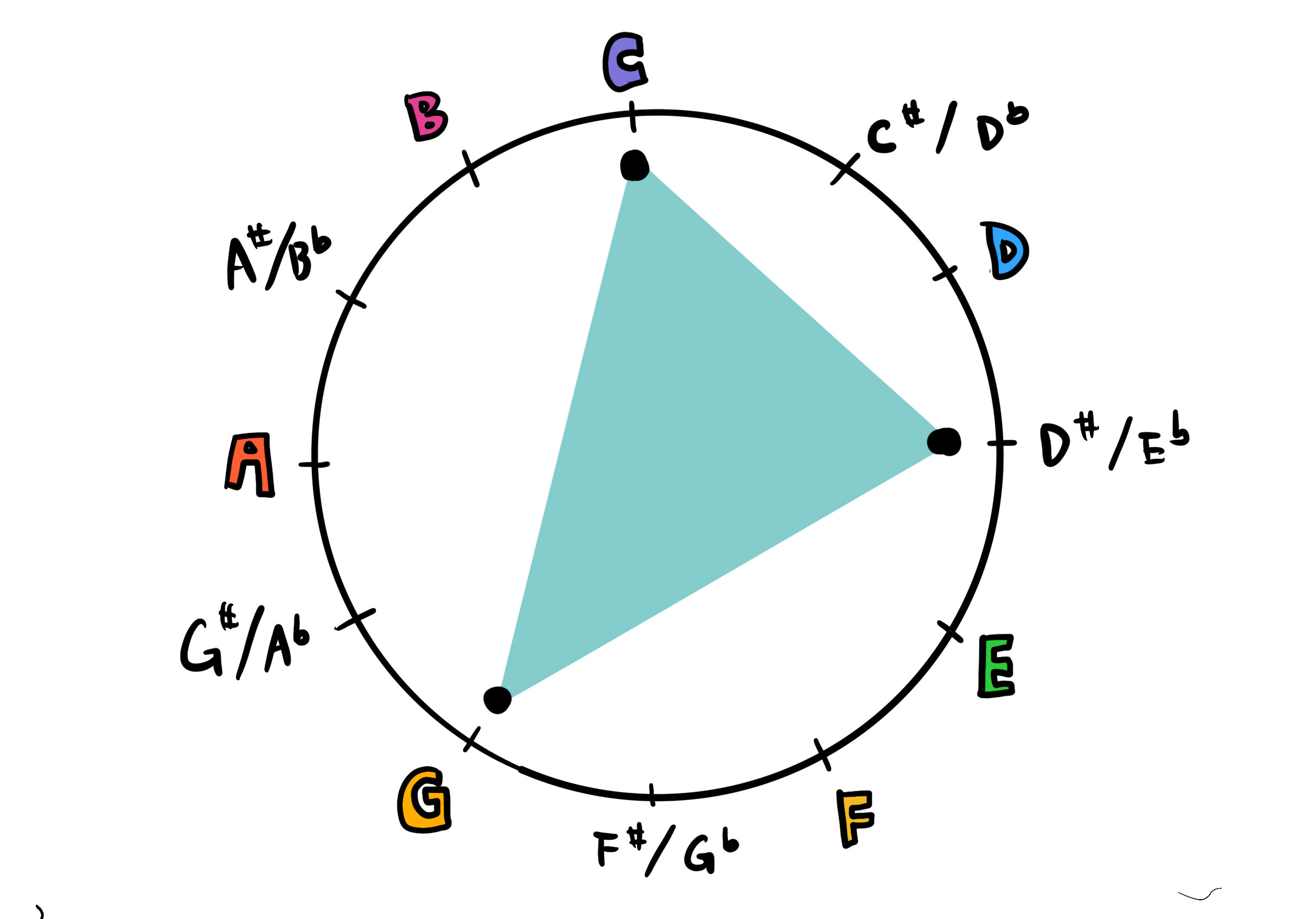
Count 3 steps (a minor third) to the next note: C.
-
Count 4 steps (a major third) to the next note: E.
Play A, C, and E together on the piano. That’s an A Minor Chord!
On the circle, find the triangle shape for the minor chord. Rotate it to start on another note. Can you hear that it still sounds like a minor chord?
Quartal Chord
A quartal chord is built using fourths instead of thirds. It can sound more open and modern.
-
Start with the C note.
-
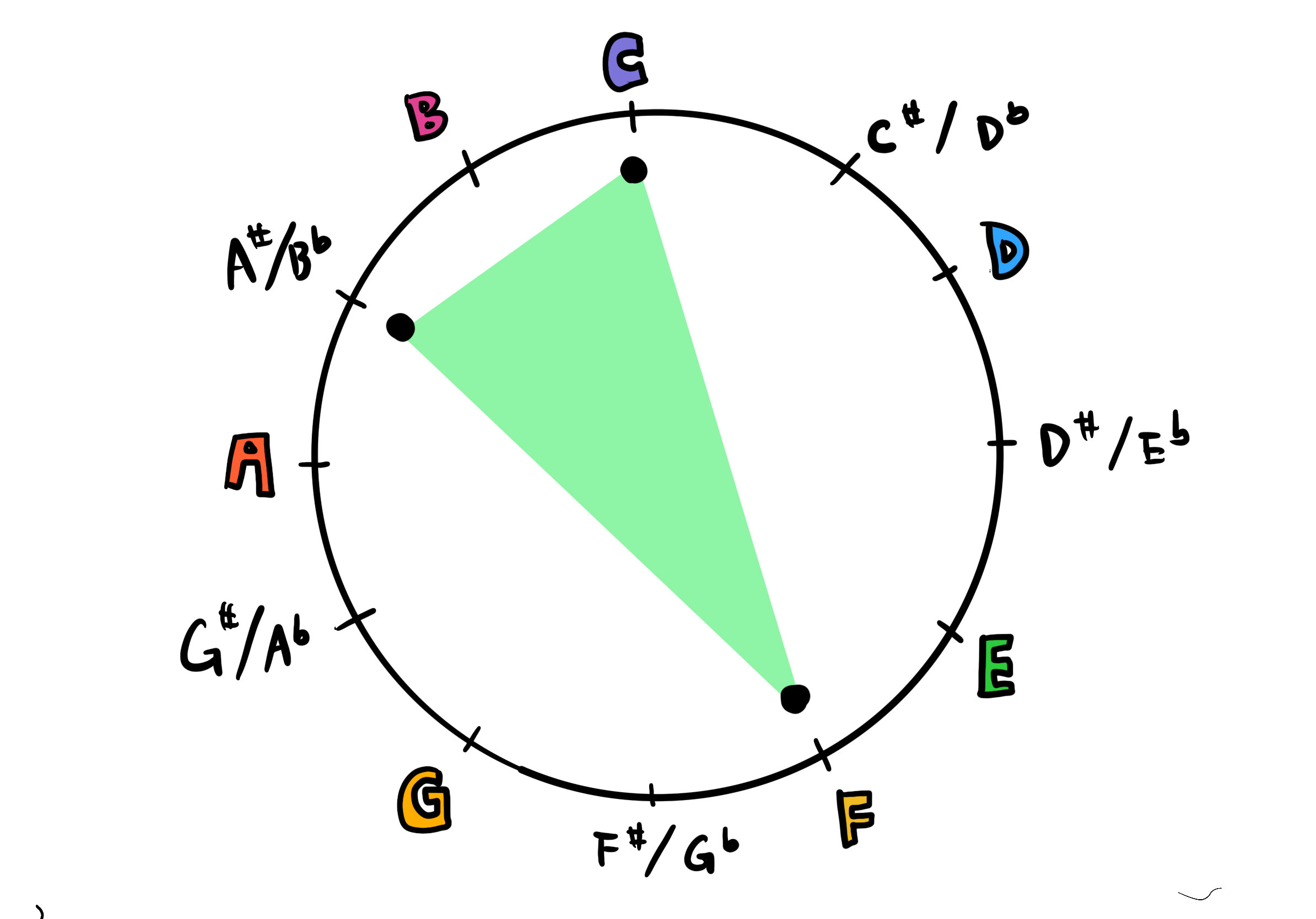
Count 5 steps (a fourth) to the next note: F.
-
Count another 5 steps to the next note: Bb.
Play C, F, and Bb together on the piano. That’s a C Quartal Chord!
Look at the triangle these notes form on the circle. Try rotating the triangle and play the new notes. Does it still have that open, modern feeling?
Notes in quartal chords are not always 5 half steps apart. Just like how both major and minor chords are made of third intervals, quartal chords are a category of chords made of fourth intervals. But let’s save that for more advanced books!
This is it!
That’s it for this book! Music is full of magic. From how sound waves move, to how scales and chords are made, you’ve learned how music works like a fun puzzle. Every note has a special job, and together they make the songs we love.
Now it’s your turn to explore! Try playing your own scales, make up chords, and draw fun shapes on the circle of notes. You can use what you’ve learned to create your own music!